

Nice pic Beasty! Taken on holiday in Tenerife more than a few years ago. It was during my P.I. days.* Enough about that though. I have made a breakthrough on identifying the make and model of The Little Turd. Go me!
Browsing eBay as per usual, I decided to search for dinghies rather than actual boats. I’ve had a lot of fun doing up the Little Turd and it has been more than satisfying getting it all pimped up. I came across a listing which looked a little familiar. Not an exact match mind you but too close to ignore.
* I may have almost qualified as an actual Private Investigator. Almost. Not quite.
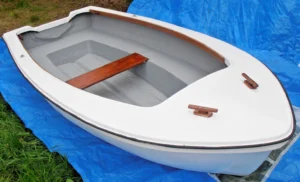
The boat is described as a Fibrocell Dolphin 10. Going on that information I’ve been doing a bit of research on Fibrocell Ltd, and I can confirm that The Little Turd is a Fibrocell 7 – used primarily as working tenders for small coastal yachts. I’m not sure if I mentioned this before, but at one point there was a plan to make a mould from The Little Turd in the hope of building another one from scratch. That idea has evolved somewhat. A little bit of an understatement actually, it’s more than evolved, it may actually become reality.
I found a dinghy mould on eBay at a very low price, and… this was the clincher, the mould is located in Harlow. Innit bruv. Plans are afoot. Stay tuned.
If you’ve read this far, well fucking done.
The below is just for me to have it documented.
Booyaka Motherfuckers!
- Hull Design: Unlike the traditional clinker-style dinghies, this model features a smooth, modern GRP finish. This was intentional to make the boat easier to clean and to prevent the hull from “grabbing” the water when being towed behind a larger vessel.
- Dimensions: While marketed as a 7-footer, they often measured exactly 7’6″ (2.28m).
- Weight: These are extremely light, typically weighing around 25–30kg, allowing a single adult to lift them onto a roof rack or a yacht’s davits.
- Seating: It usually features a single central rowing thwart (bench) and a small seat integrated into the stern buoyancy tank.
- The Heritage Look: The clinker-effect hulls (like the 8 and 10) for users who wanted a classic wooden boat aesthetic.
- The Utility Look: The smooth hulls (like your 7-foot model and the Dolphin series) for users prioritizing weight savings and ease of maintenance.
- Edge Design: The top rim is typically a “rolled” edge or a thickened GRP flange. This provides structural rigidity to the hull without the need for heavy timber.
- Buoyancy: Since it’s an all-fibreglass construction, the “seats” at the bow and stern are likely completely sealed hollow tanks. This makes the boat virtually unsinkable.
- Rowlocks: You likely have metal rowlock sockets (often nylon or galvanized steel) bolted directly through the reinforced fibreglass edge.
- Usage: These were perfect for “rugged” use as “pond boats” or as a working tender for small coastal yachts where weight and ease of cleaning were more important than traditional looks.
- The Model: Since it’s ~7 feet, smooth-hulled, and all-fiberglass with a blue interior, you likely have the standard utility version of the Fibrocell 7.
- Production Era: This color scheme was most popular during the mid-to-late 1970s. Earlier models tended to be solid white or used more wood, while later 80s models often moved toward all-white or light grey to look more “modern.”
- Construction: The blue you found is likely the original gelcoat (the hard outer layer of the fiberglass) rather than paint. This is the most durable part of the boat, which is why it survived under layers of old paint.
- Safety Rating: With both tanks intact, the boat is designed to support its own weight plus the weight of a small outboard motor while submerged.
- The “Air Test”: Since you’ve been sanding and refurbishing, check for any small drain plugs or bungs on the vertical faces of these tanks. If they have them, it’s worth opening them to see if any water has seeped in over the years (condensation is common).
- Construction Style: In the 1970s, Fibrocell often used a “chopped strand mat” (CSM) layup for these small tenders. It makes the hull slightly thicker and more “rigid” than modern vacuum-molded boats, which is why it has likely survived being painted numerous times without cracking.
- Maximum Weight: Approximately 150kg to 180kg (330–400 lbs).
- Passenger Limit: It is strictly a 2-person boat for calm water. If you are using it in choppy conditions or as a yacht tender in a busy harbour, it is safest with one adult plus gear.
- Motor Weight: This total must include your outboard. A small 2hp petrol motor (approx. 13kg) or an electric setup (approx. 10kg) is fine, but you have to subtract that from your passenger weight.
- Hull Weight: The “all-GRP” smooth-hull version is lighter than the clinker models because it lacks the extra fiberglass required for the “stepped” plank effect. At roughly 25 kg, it is light enough to be carried by one adult or easily lifted onto a car roof rack by two people.
- Impact of Built-in Tanks: The blue-trimmed buoyancy tanks at the bow and stern contribute to this weight but are essential for safety. If the boat feels significantly heavier than 30 kg when dry, it may have trapped water or condensation inside those sealed cavities.
- Portability: This compact weight was a primary selling point for the 7-foot model, as it was designed to be easily stowed on the deck of a larger yacht or handled by a single person for inland pond use.